Map your operations.
Fix what matters.

Yone is a process intelligence consultancy. We work alongside operational leaders to understand how the business really works, identify what's holding it back, and build the clarity your teams need to act.

Engagement output example
10+
Processes mapped
6
Recommendations
40%
Effort identified
4 wks
Time to delivery
Discovery
Analysis
Roadmap
Handover
Process mining AI-ready Requirements Change-ready
Use Cases

Frame the problem.
Drive a measurable result.

Each use case starts with the operational reality, maps what needs to change in your processes, and points to an outcome you can measure and defend.

Sector:
Domain:
Objective:
Improve Construction

Build the Golden Thread from day one, not after the audit

The Building Safety Act requires a continuous Golden Thread of information. In practice, contractors build it retrospectively, under pressure, with incomplete records.

In practice, the Golden Thread gets built retrospectively — scrambled together under audit pressure, not maintained from day one as the Act requires
The process

Design review → Planning approvals → Construction → Handover → Occupation

The change

Map HSE and Golden Thread control activities into the construction process hierarchy. Attach the document, system, and responsible party to each control point at every stage.

The result

Continuous compliance evidence, faster handover sign-off, reduced liability exposure.

Improve Software

Subscription growth exposes every gap in your contract and billing process

As volumes grow, contract variations, upgrade and downgrade paths, and billing edge cases multiply. Without a documented process, every exception becomes a manual intervention.

Subscription revenue leaks quietly — billing edge cases, failed renewals, and undocumented upgrade paths compound invisibly until they show up as churn you can't explain
The process

Contract creation → Subscription activation → Billing cycle → Renewal → Upgrade / downgrade → Cancellation and offboarding

The change

Map the full subscription lifecycle. Document decision points for contract variations and connect each billing activity to the CRM and billing system. Use AI to surface exceptions that bypass standard flows.

The result

Fewer billing errors, faster renewal cycles, reduced churn from process failure rather than product failure.

Transform Manufacturing

Build the case before you buy the system

System investment decisions are made on vendor demos, not on a clear picture of what the current process actually requires and where it genuinely breaks.

ERP programmes fail on budget and timeline when the operational model wasn't mapped before system selection began — every time, without exception
The process

The affected L0–L2 scope, whatever the investment is meant to fix, mapped in current state first

The change

Document current state. Run AI scenario simulation to model the future state. Identify the activities that change, the data that moves, and the roles affected, before the vendor is selected.

The result

Cleaner requirements, shorter vendor selection, significantly lower implementation risk.

Improve Food & Perishable

Do you do what Food Safety requires, and can you prove it?

UK Food Safety and Hygiene regulations require documented hazard controls at every stage. Businesses have the policy, but rarely the operational evidence to back it up.

Food safety enforcement traces to how procedures are carried out, not contamination events — documented process controls are the compliance asset, not the paperwork
The process

Intake → Storage → Preparation → Production → Packaging → Distribution

The change

Map each process activity against its legal requirement, HACCP control point, temperature record, allergen check. Compliance becomes a property of the activity, not a separate document.

The result

FSA inspection readiness, documented HACCP compliance, reduced enforcement risk.

Improve Financial Services

Consumer Duty requires evidence, not just policy

FCA Consumer Duty demands that firms demonstrate how their customer-facing processes deliver good outcomes across price, product, service, and communication. Firms have the policy. Few have the process map that proves it.

The firms that struggle with Consumer Duty aren't the ones without policies — they're the ones that can't show the operational process that actually delivers them
The process

Customer-facing L1 processes: onboarding, advice, complaints, renewals, and communications — mapped against the four Consumer Duty outcomes

The change

Cross-reference each process step with the outcome it is designed to deliver. Identify where the process supports the duty — and where there is no process behind the promise.

The result

Audit-ready evidence of Consumer Duty compliance, a clear ownership map for each outcome, and a prioritised backlog of process gaps to close.

Prove Financial Services

Prove your processes are aligned with your risk management framework

Risk appetite statements and control frameworks live in governance documents. The processes that implement those controls live elsewhere. The gap between the two is where incidents happen — and where regulators look first.

PRA PS6/21 requires UK financial firms to map important business services to their underlying operational processes — yet the majority treated it as a documentation exercise, not a living operational map
The process

Risk-relevant L1 and L2 processes mapped against the firm's control framework, risk taxonomy, and SMCR responsibilities

The change

For each risk control, identify the process step that implements it. Surface controls with no operational process behind them — and process steps with no control accountability. Cross-reference against Senior Manager responsibilities.

The result

A traceable map from risk appetite to operational activity, clear Senior Manager attestation evidence, and a defensible position in any regulatory review or incident investigation.

Improve Software

Feature sprawl is a process problem before it is a product problem

As the product grows, the gap between what is in the catalogue, what has been built, and what customers expect widens. Keeping product, sales, and operations aligned requires a shared model.

The overwhelming majority of features in any mature product are rarely touched — yet teams keep building, without a clear view of what's actually used or why
The process

Feature request → Prioritisation → Development → Release → Catalogue update → Customer communication → Billing tier alignment

The change

Map catalogue management alongside the development lifecycle. Connect each feature release to the customer segments it serves and the subscription tiers that include it.

The result

Tighter product, sales, and ops alignment. Fewer surprises in contracts, sustainable catalogue growth without operational debt.

Transform Software

Model what your operation looks like at 2× volume, before you hire

Growth planning happens in spreadsheets. Headcount decisions are made without knowing which process activities break first when volume increases.

Rapid scaling without documented processes creates hidden cost inflation — manual workarounds, inconsistent decisions, and uncontrolled exceptions all compound as volume grows
The process

Capacity-constrained L1 processes, typically fulfilment, service delivery, or customer support

The change

Use scenario simulation to model increased volume against current activity assignments. Surface bottlenecks, capacity gaps, and automation targets, before committing to headcount.

The result

Evidence-based headcount plan, identified automation targets, growth without proportional cost increase.

Transform Manufacturing

Find what you can fix this quarter, before committing to a programme

Large transformation programmes get funded while obvious operational inefficiencies keep running. Quick wins are invisible because no one has mapped them.

The highest-value operational improvements are almost always process changes that require no system investment — the technology already exists, sitting underused
The process

Any L1/L2 process, reviewed by AI for manual effort, failure points, and missing system support

The change

Use AI to surface activities with high manual effort or known failure points. Prioritise by effort vs. impact, no programme budget required.

The result

A ranked improvement backlog. Changes executed inside existing capacity, before the programme starts.

Improve Manufacturing

Every order is different. Your process shouldn't be.

Custom orders bypass standard processes, creating a shadow operation that generates rework, delays, and quality escapes outside normal controls.

Digitalisation in manufacturing delivers the biggest gains not from new technology alone, but from mapping and standardising the processes that technology will run on
The process

Order intake → Configuration → Engineering sign-off → Production → QC → Delivery

The change

Document the bespoke order path as its own L1 process, with defined decision points for configuration checks, capacity allocation, and non-standard approvals.

The result

Accurate lead-time quoting, fewer mid-order surprises, cost control on custom work.

Improve Software

Your pipeline is only as good as the process behind it

CRM data shows what's in the funnel but not why deals stall, why DSO is high, or where lead quality drops off between stages.

Sales teams with a defined, documented process consistently outperform those without one — and the gap compounds at every stage from qualification to close
The process

Lead → Qualification → Proposal → Negotiation → Close → Customer Onboarding

The change

Map each stage, assign activities to roles, connect to CRM and contract tools. Identify where handoffs fail and which activities are undefined or inconsistent.

The result

Shorter sales cycles, lower DSO, higher conversion from qualified lead to signed contract.

Improve Manufacturing

From concept to production, with a process that scales

NPD runs differently every time. Stage gates are informal, handoffs between R&D, engineering, and production are undocumented, and PPAP requirements arrive too late.

Product organisations with a structured development process consistently reach market faster and with fewer late-stage changes than those that don't
The process

Concept → Design → Prototype → Validation → PPAP → Production Release

The change

Map the full NPD flow including PPAP requirements at each validation stage. Connect activities to quality systems, tooling approvals, and supplier qualification milestones.

The result

Fewer late-stage surprises, compliant PPAP documentation, faster customer approval and production launch.

Improve Construction

Win more tenders by knowing exactly how you write them

Tender quality is inconsistent because the process for producing one isn't documented. The best bids rely on the best individuals, not the best process.

Organisations with a standardised bid process win more — and the margin widens when that process is applied consistently across opportunity sizes
The process

Opportunity identification → Bid/no-bid decision → Content development → Review → Submission

The change

Document the full tender process, capture quality gates, and use AI to propose standard sections based on previous wins.

The result

More consistent bid quality, faster turnaround, institutional knowledge retained when key people leave.

Improve Construction

Your subcontractors are part of your process. Treat them that way.

Subcontractor onboarding, compliance checking, and performance management are handled ad hoc. Issues surface during delivery, not before it starts.

Construction project delays trace to supply chain failures that weren't visible in the programme plan — undocumented subcontractor dependencies are consistently where programmes unravel
The process

Procurement → Qualification → Mobilisation → On-site performance → Closeout

The change

Document the full subcontractor lifecycle. Attach compliance check activities to the relevant certifications (CSCS, RAMS, insurance) at each process stage.

The result

Fewer on-site incidents, better programme control, defensible procurement records.

Improve Higher Education

From application to enrolled student, without the bottlenecks

Enrollment is high-volume and time-critical, involving multiple departments and student touchpoints. Handoff failures and delays lose students before they start.

The biggest conversion lever for any university isn't marketing spend — it's the process from offer to registration, which is rarely documented and even more rarely owned
The process

Acquisition → Application → Admissions → Offer → Enrollment → Registration

The change

Map the full enrollment journey. Identify where applications stall, which activities are manual, and where communications fail between departments.

The result

Faster time-to-offer, fewer dropped applications, measurably higher conversion rates.

Improve Manufacturing

Know exactly how you manage the suppliers you depend on

Supplier management is spread across teams and systems. No single view of onboarding, performance, contract renewal, or risk, until something breaks.

Supply chain disruptions can erase a full year's profit — and the real resilience gap is operational visibility, not bigger inventory buffers
The process

Identification → Qualification → Onboarding → Performance review → Contract renewal → Offboarding

The change

Map the supplier lifecycle end-to-end. Assign activities, systems, and data owners at each stage. Surface process gaps that create single points of failure.

The result

Fewer supplier surprises, consistent performance reviews, faster onboarding for new partners.

Improve Manufacturing

Build your alternative partner network before you need it

Most operations run on a short list of preferred suppliers. When one fails — a delivery shortage, a quality issue, a compliance breach — there is no documented fallback. The alternative list exists in someone's head, not in the process.

The businesses hit hardest by supply chain disruption are the ones that didn't know they had a single point of failure — until it failed
The process

Supplier qualification → Tier 1 and Tier 2 mapping → Alternative sourcing criteria → Onboarding steps → Activation conditions

The change

For each critical supply relationship, document a qualified alternative alongside clear switching criteria — volume threshold, lead time breach, quality failure. Turn an emergency call into a documented process step that any team member can execute.

The result

Reduced disruption exposure, faster recovery times, and a supplier base you can audit — not just phone.

Improve Food & Perishable

Your quality process is only as strong as your weakest supplier

Quality failures in the finished product are often supplier failures in disguise. Without extending quality requirements into how your suppliers operate, you can only react to failures — not prevent them.

Quality failures in UK manufacturing originate in the supply chain, not on the production floor — yet quality processes consistently stop at the factory gate
The process

Supplier quality standards → Incoming goods inspection → Non-conformance reporting → Supplier corrective action → Performance review

The change

Define quality requirements at the supplier level, not just at goods-in. Map how each critical supplier's process connects to your quality gate, and what constitutes a non-conformance that triggers a review or switch.

The result

Fewer late-stage quality failures, traceable supplier accountability, and a quality process that extends beyond your own walls.

Improve Higher Education

Measure what support you're providing, and whether it works

Learning support services grow organically and are rarely connected to measurable outcomes. Resource allocation follows demand, not impact.

Students who engage with structured learning support are significantly more likely to complete — yet few institutions can trace who accessed what, or whether it made a difference
The process

Referral → Assessment → Intervention → Review → Outcome, linked to student record systems

The change

Document the full support process, connect activities to student outcomes, identify where cases fall through the cracks between departments.

The result

Better resource allocation, evidenced impact for regulatory reporting, lower dropout rates.

Prove Financial Services

Walk into any audit with confidence

Audits surface gaps that everyone knew about but nobody documented. The scramble to produce evidence is expensive, and exposes real weaknesses at the worst moment.

Process documentation is the asset that pays back across every certification cycle — organisations with mature process maps spend measurably less time preparing for audits
The process

Any L1/L2 process, with control points, business rules, and known failure modes attached at activity level

The change

Attach the control (what must be true), the evidence (what proves it), and the failure point (what can go wrong) to each activity. Audit readiness becomes a byproduct of process documentation.

The result

Shorter audit cycles, faster certification renewals, fewer findings.

Prove Financial Services

Do your people actually do what your process says?

Documented processes and actual practice diverge over time. The gap only surfaces in incidents, complaints, or audit findings, never before.

Operational incidents trace to how processes are followed — or not followed — not to system or technology failures
The process

Any L2 process with defined activity steps, used as the baseline for a practice review

The change

Compare documented activity steps against actual practice. Highlight divergences as improvement items, before they become incidents or findings.

The result

Closed compliance gaps, evidence of active governance culture, reduced incident rate.

Prove Software

Map what you promise against what you actually deliver

Customer journey maps and internal process maps are built by different teams and never connected. The gap between expectation and delivery is invisible until a complaint.

Customers who leave rarely complain — by the time a process failure shows up in NPS or complaints data, the damage is already done
The process

Customer-facing L1 processes, onboarding, service delivery, billing, support

The change

Overlay persona expectations and moments of truth onto your actual process activities. Where expectation isn't met by the activity, that's your improvement target.

The result

CX improvements grounded in operational reality, not just journey-mapping workshop outputs.

Know Software

Show investors how you operate, not just what you do

Investors and acquirers buy confidence in execution, not just the product. Early-stage teams have the vision documented, but rarely the operational model behind it.

In M&A due diligence, operational maturity — how well a business documents and manages its processes — is consistently a differentiating factor in valuation confidence
The process

L0 framework covering Sales, Delivery, Finance, and Operations, linked to systems and capabilities

The change

Replace slide decks with a navigable operating model. Map your core processes, show how systems connect, and demonstrate you control the operation.

The result

Faster due diligence cycles, higher buyer confidence, fewer late-stage surprises.

Know Higher Education

Replace the 60-page handbook with a process map

New team members spend weeks piecing together how the business actually works, from scattered documents, tribal knowledge, and shadow processes.

Structured onboarding programmes significantly reduce time-to-productivity and improve 90-day retention — the difference between a week of induction and a 90-day process is measurable
The process

Any L1 process relevant to the new role, assigned directly on day one

The change

The new hire navigates the relevant process map from day one, the flow, the systems, and their role in context. No translation needed.

The result

Faster ramp-up, fewer first-90-day errors, consistent knowledge as the team scales.

Know Construction

Map your systems and data, not just your org chart

IT knows the architecture. Operations doesn't. When something breaks or needs replacing, no one can quickly answer which processes that system supports.

Requirements failure — not technical failure — is the real cause of IT project overruns and cancellations. The technical team almost never gets it wrong; the brief does
The process

L2 process activities, each detailing the system used, data touched, and integration points, written as pseudo-code for functional specs

The change

Document each system's role at the activity level. Use L2 detail as the starting point for system replacement briefs and IT requirements.

The result

Better IT requirements, faster incident resolution, cleaner system replacement projects.

No use cases match the current filter.
Why it matters

The value you walk away with.

Process and business analysis isn't always the root issue - but it's almost always the fastest way to get to it. Here's what typically changes.

Be ready for what's coming

Growth, a new system, a transformation - are your processes fit for it? Documented and reviewed before the pressure hits, not during.

Outcome: operational transformation

Reduce friction and improve performance

Waiting time, error rates, rework - often traced back to a work allocation rule, an inconsistent decision criterion, or a business rule no one wrote down. Small fixes, real gains.

Outcome: faster, leaner operations

Improve control and oversight

Who does what, who owns what, who approves what, and what the rules actually are - documented and agreed. Onboarding, audits, and management reviews all get easier.

Outcome: stronger governance

Meet compliance and certification requirements

Regulators and certification bodies want evidence, not intentions. Documented processes, defined roles, and traceable business rules give auditors exactly what they ask for.

Outcome: audit-ready, certification-ready
How we work

Structured. Fast. Actionable.

A proven 4-step approach. Typically delivered in 3–4 weeks.

01

Frame the scope

We align on objectives, define boundaries, and identify the right people to involve from day one.

02

Discover & document

Workshops, interviews, and data review. We get into the real operation - not the ideal version of it.

03

Analyse & structure

We turn what we learn into clear deliverables: diagrams, rules, data models, epics.

04

Hand over & stay available

A proper transition - not a document drop. We walk your teams through findings and stay close.

Small team. High focus. We keep engagements tight so the right expertise stays on your problem from start to finish.

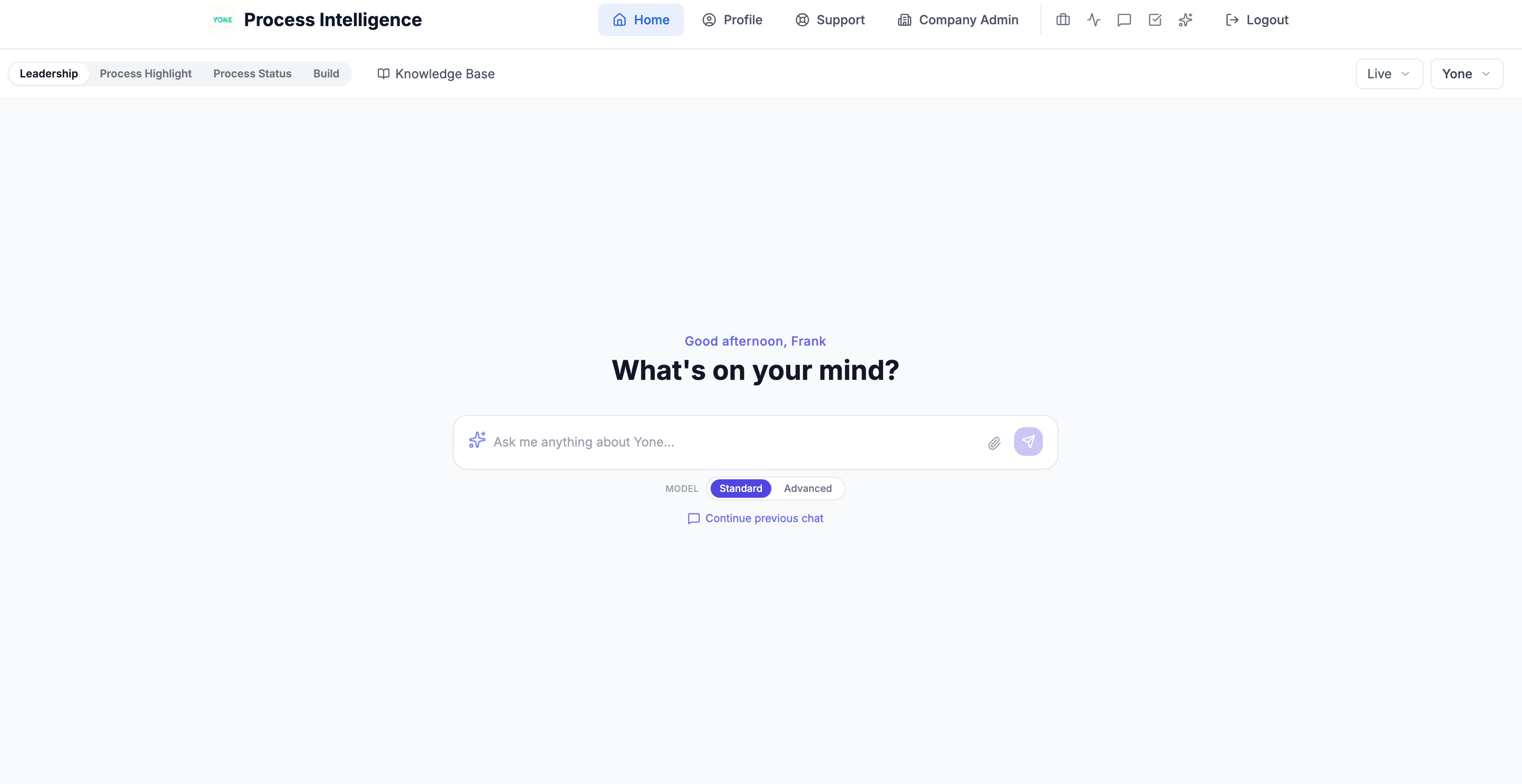
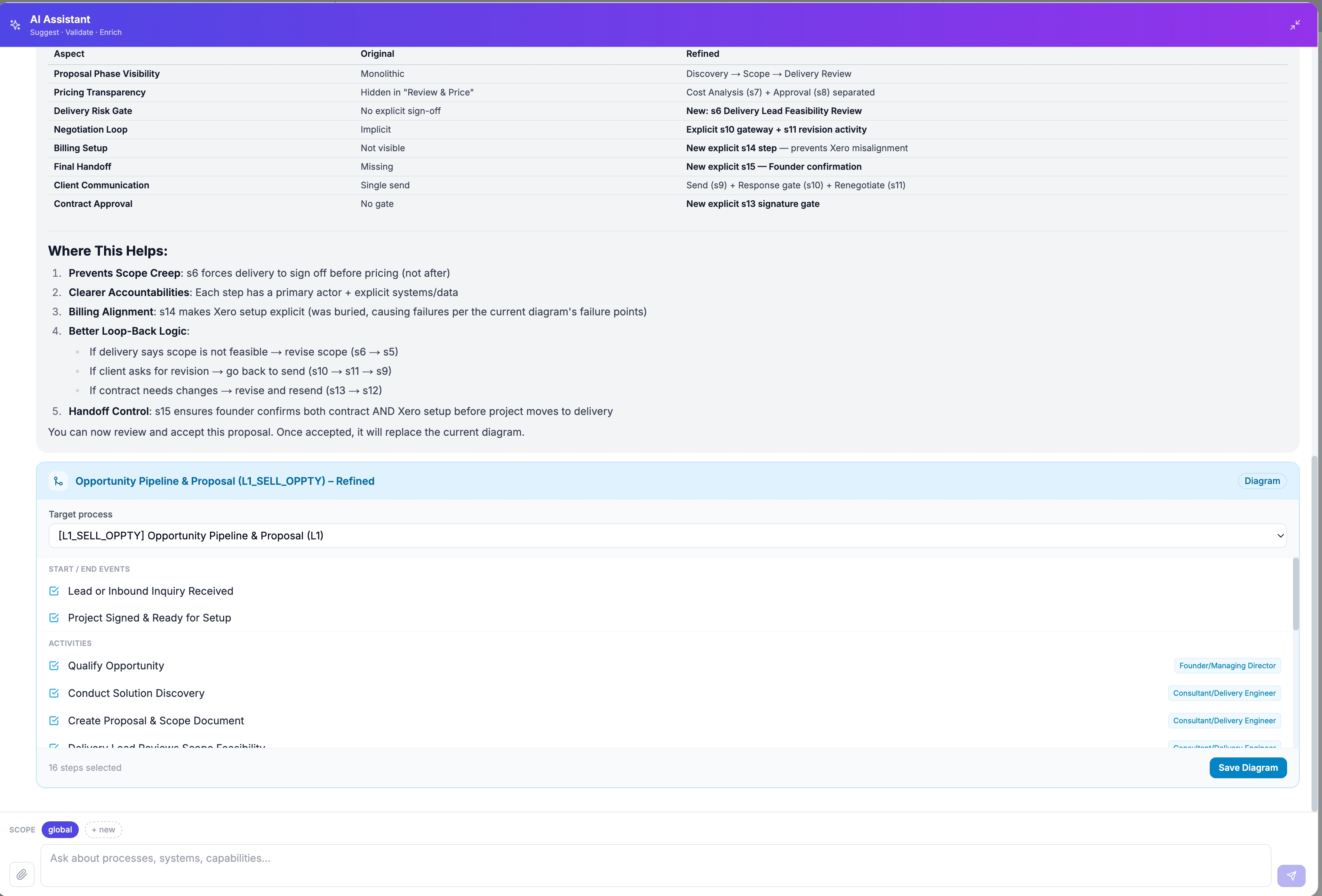
Yone Process Intelligence Our platform helps you map, manage, and share your operating model — processes, systems, capabilities, and data — all in one place.
Learn more
What you get

Outputs you can act on.

Every engagement ends with clear, structured deliverables - not vague recommendations.

Process maps

End-to-end flows across roles and systems - as-is today, with gaps and improvement areas marked.

Data & object models

A structured picture of what data you hold, how it flows, and where it's inconsistent or missing.

Business rules

The logic behind your operations - documented, validated, and ready to drive system design or automation.

Requirements & epics

Structured requirements your project or product team can pick up and run with. No translation needed.

Performance analysis

Where volume concentrates, where SLAs slip, and where the biggest improvement opportunities sit.

Roadmap

A prioritised view of what to tackle first - grounded in impact, feasibility, and your strategic direction.

"

This is exactly how we work.

"

Those are the discussions and decisions we needed.

"

Great to work with Yone.

Let's talk

Ready to see clearly?

Tell us what you're facing. We'll be straight about whether we can help - and how fast.