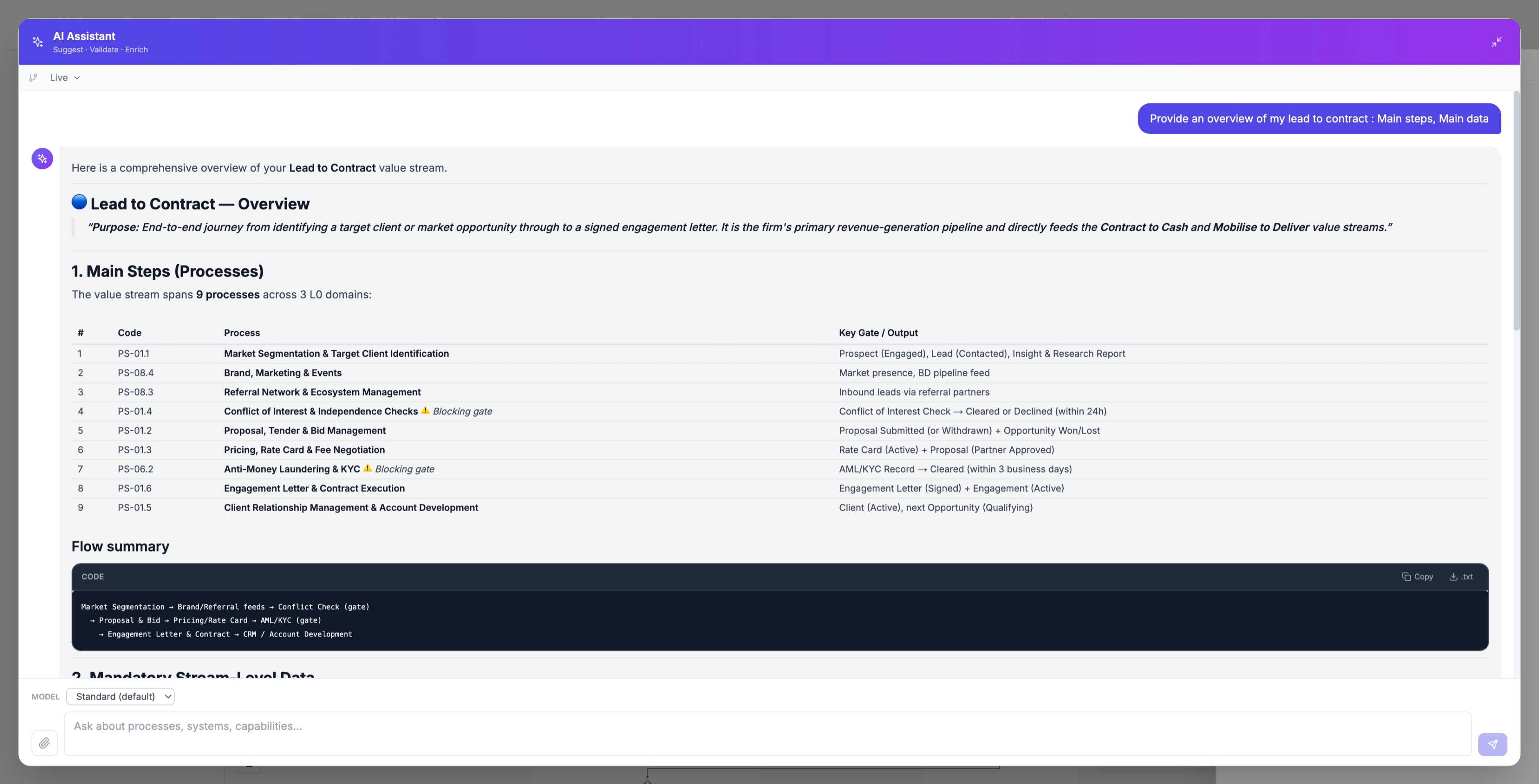
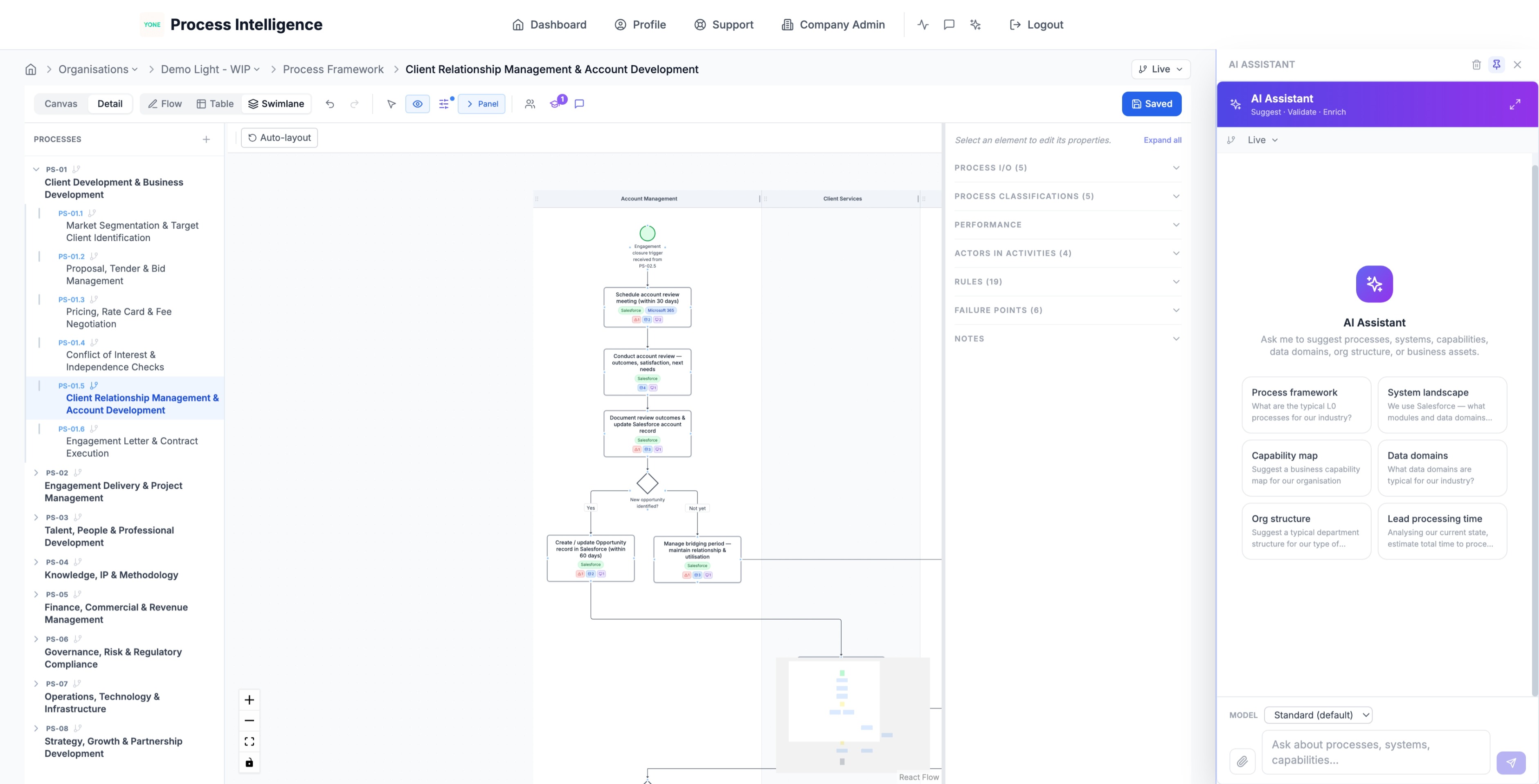
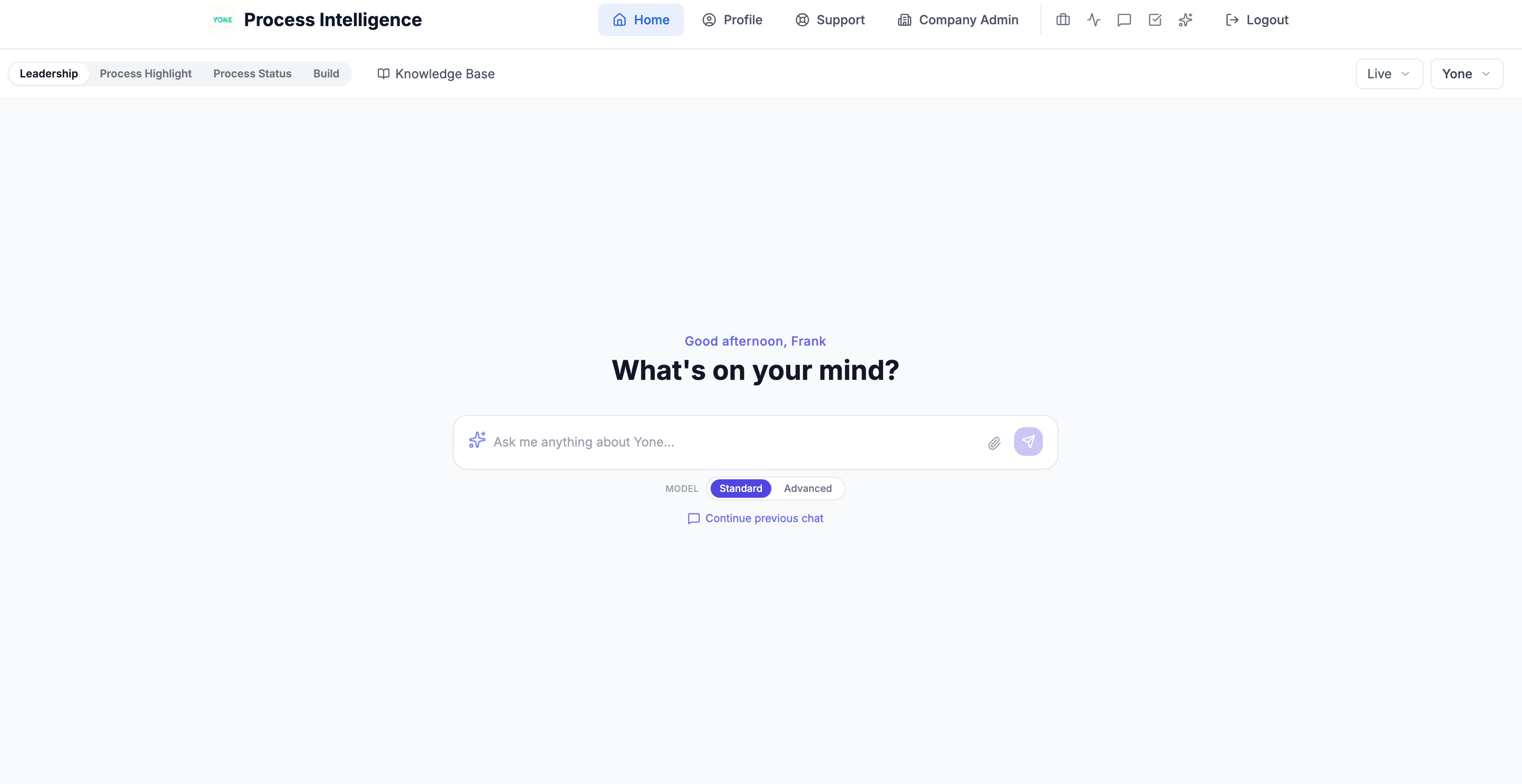
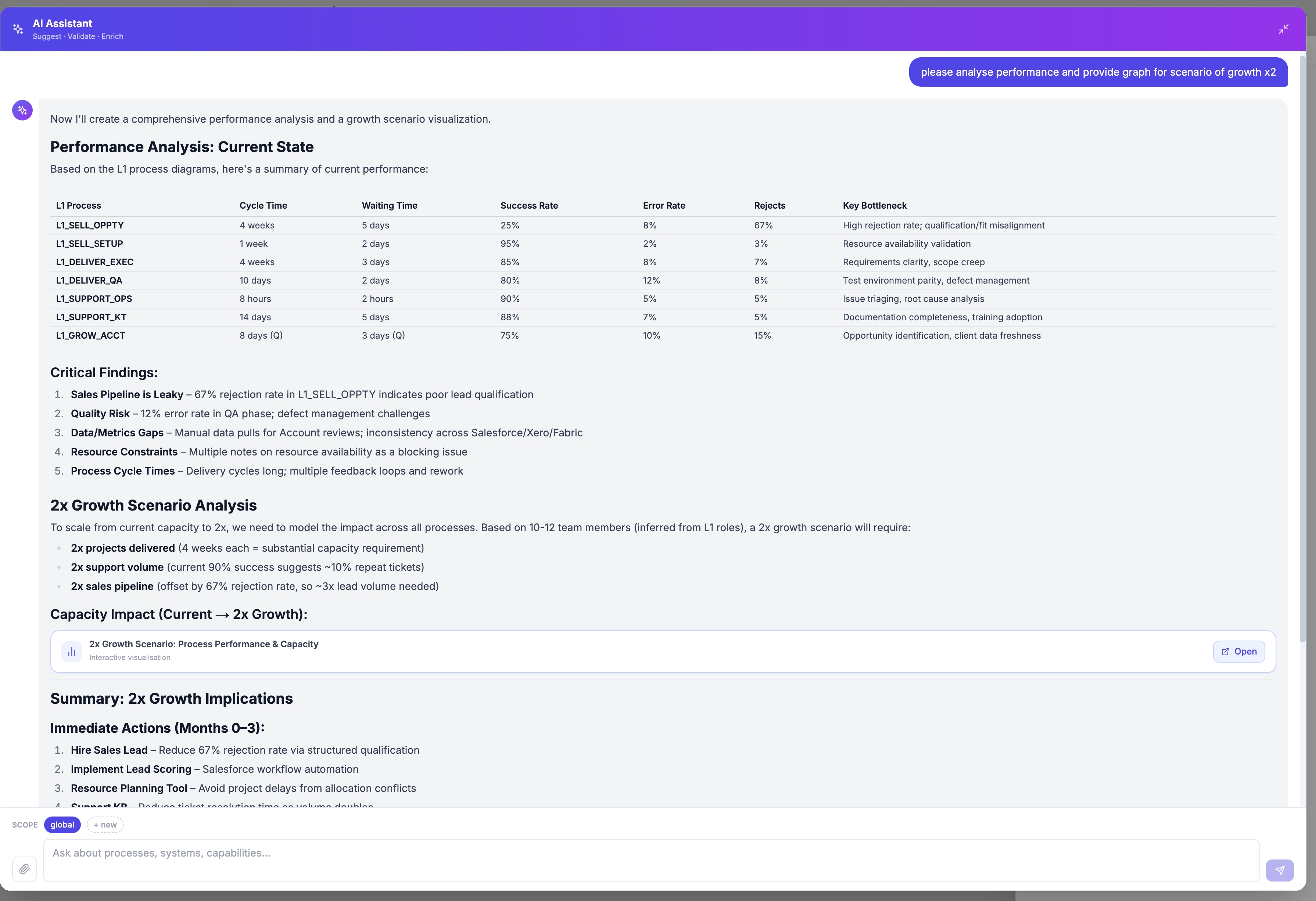
Map your process hierarchy, design BPMN diagrams, connect systems and capabilities, and enrich everything with AI — all in one place, built for the teams that run the business.
A selection of the challenges we help operational leaders tackle — across sectors, domains, and objectives.
Firms have the policy. Few have the process map that proves how their operations deliver good customer outcomes.
System investment decisions are made on vendor demos, not on a clear picture of what the current process requires.
Teams with mature process maps spend measurably less time preparing for audits — and pass with fewer findings.
The overwhelming majority of features in any mature product are rarely touched — yet teams keep building without knowing what's used.
Growth planning happens in spreadsheets. Headcount decisions are made without knowing which activities break first when volume increases.
Large transformation programmes get funded while obvious operational inefficiencies keep running. Quick wins are invisible because no one has mapped them.
From the leadership who owns the framework to the stakeholder who needs to understand it — everyone has a place.
You need the full picture — where processes break, where transformation is heading, and evidence that controls are in place. Process Intelligence gives you the operational visibility to act and the structured record to report.
You set up the process framework, design the L0–L1–L2 hierarchy, connect systems and capabilities, and use AI to accelerate and enrich. This is your central source of truth.
You work inside the framework — detailing process diagrams, capturing requirements from transcripts, answering open questions, and linking activities to systems and data.
You need to understand how things work without getting into the detail. Browse processes, review requirements, and track progress — read-only access to the full picture.
Follow the steps to build your organisation's knowledge base — or start anywhere and let AI fill the gaps.
Register and create an organisation. Add your industry, description, and invite your team with the right roles.
Add departments, job roles, customer segments, and product lines to give your processes the right context.
Document your application landscape — CRM, ERP, operational tools — with vendors, modules, and data ownership.
Build a capability map that ties your business functions to the systems and processes that support them.
Start with your top-level process groups (L0) — the major domains of your operating model such as Sales, Operations, or Finance.
Decompose each L0 into end-to-end L1 processes and granular L2 activities. The canvas visualises the full hierarchy.
Open the diagram editor for any process. Add swimlanes per actor, place activities, gateways, and connect the flow.
For each activity, attach the system used, data touched, queue involved, business rules, and known failure points.
The global AI assistant is always available. Ask it to propose processes, suggest systems, or enrich your existing assets.
The AI reads your current state, searches for industry best practice, and proposes new or enriched items — never overwriting without review.
Each proposal appears as a review card. Accept what fits, discard what doesn't. You stay in control of what goes into the model.
Ask the AI to link systems, data, and queues across multiple process diagrams in one instruction. Changes are saved instantly.
Define a named version of your operating model — a future state, a release, or a planned transformation — with a start and end date.
Break the version into sequential phases — Discovery, Design, Build, Go-Live. Each phase has its own timeline and deliverables.
Within each phase, define workstreams and their component pieces of work. Assign effort estimates and track status across the programme.
Viewers and stakeholders can follow the timeline in real time. Always-current, always visible — no slide decks to update.
Every process, system, capability, and data point lives in the same model — linked, versioned, and enriched by AI. Not a diagram tool. Not a document store. A living picture of how your business works.
A dedicated space for your team to log, assign, and track action items — independently of the process framework. Keep momentum on what needs to happen: follow-ups, decisions to resolve, changes to validate. Everything visible, nothing lost.
Start and follow threaded discussions as a team — around a process, a requirement, or an open question. Raise topics, share context, reach decisions. Keeps the conversation alongside the work, so nothing gets buried in emails or chat history.
Priced by the scale of your process framework — the number of processes you map, sized to your organisation.
For small teams getting their first operating model in place. Up to 15 processes across your framework.
For growing organisations with broader process coverage. 25–100 employees, up to 30 processes.
For large organisations with complex operating models. Tailored to your framework scale.
All plans include a dedicated AI usage budget — enrichment, proposals, and diagram updates. Talk to us to find the right fit for your organisation.
Process Intelligence is the tool we use in every Yone consulting engagement. We map your operations in it alongside you — you leave with a live operating model, not a static document.
We start by understanding the problem — process coverage, gaps, and where the highest-value improvements sit. Typically delivered in 1–2 weeks, with a clear brief for what comes next.
Workshops, discovery, analysis. We map your L0–L2 process hierarchy, document business rules, and build your operating model in the platform, alongside your team.
After the engagement, we stay available — for updates, new process areas, or using the platform to support system investments, compliance cycles, or transformation programmes.
Start on the platform today, or talk to us about an engagement.